This summer, I traveled through a few countries in Europe and visited some of the most famous museums showcasing timeless works of art. As a little introduction to this blog entry, I’ll be focusing on the incorporation of fashion within paintings, mostly from the past, that left a strong impression on me and stood out for their unique approach.
PS* These reviews or descriptions are simply reflections of what I’ve noticed, more thoughts (not facts). In this blog, I zoom in/zoom out, and look deeper within the paintings . This may or may not resonate, but that’s the beauty of variety in styles and fashion = every opinion can change the way a look is perceived, which adds new layers of perspective.
The first museum I visited this summer was in Bergamo, Italy. Me and my girlfriends visited the Accademia Carrara, which explored works of artists in the 16th century and used to be a school of art (this is a half fun fact, half context in a way). 16th century art applied emphasis on shimmer and attention to detail with jewelry (in portraits at least). In the portrait of Luciana Brembati, her jewelry stands out immensely, but her dress and headpiece also innovate her look. The dress has very unique, maybe crocheted, yellow fabric, and the headpiece covers most of her hair, perhaps to highlight her face more? Her Look symbolizes wealth, royalty and the higher class.
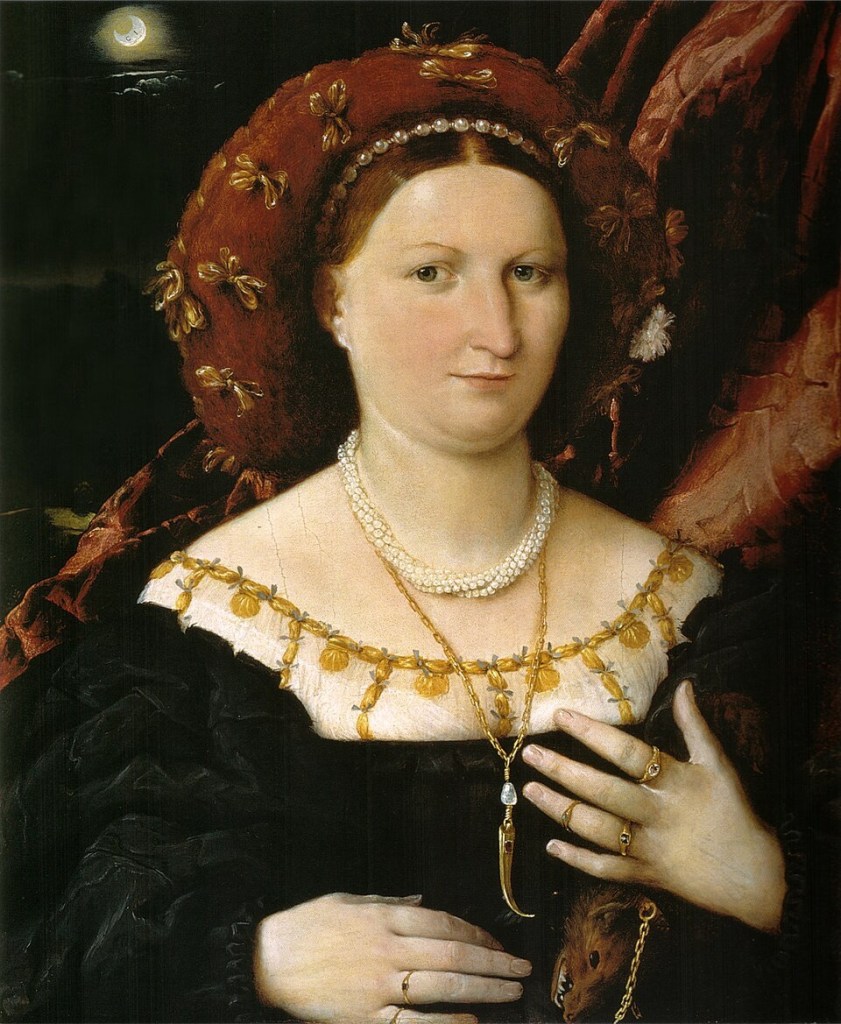
In the Accademia Carrara.
In Madrid, Spain, the Museo Nacional del Prado was my favorite by far. I went there twice, maybe even three times. I’m going to talk about the famous Las Meninas by Diego Velázquez, which shows the little girl Margarita (I’ll mention her further in the blog too).
Here, I want to talk about how most of the little girls are wearing gowns with corsets. The men in the back are dressed in dark colors and maybe even capes (just describing what I’m seeing). This could simply be because they weren’t as important for the painting, or perhaps they represented male fashion within the hierarchy.
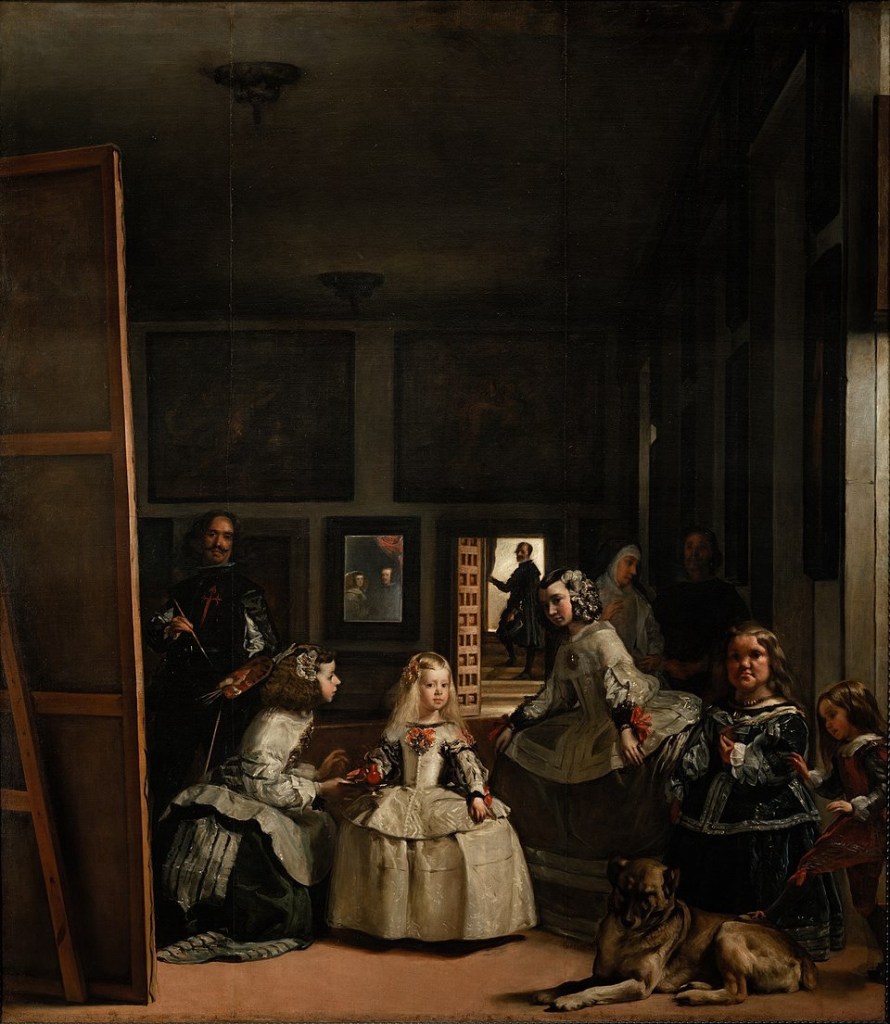
In the Museo Del Prado.
Then we also visited the Thyssen-Bornemisza National Museum, which features artists like Boudin and Monet. Their works (I don’t have a specific example) often capture the textures, colors, and elegance of clothing, showing how fashion was intertwined with everyday life and social identity at that time.
In Milan, Italy, we visited Gallerie d’Italia, where I deeply, deeply loved The Dance of the Hours by Previati. It shows angels in the sky, filled with beautiful colors, flying in an oval circle in the shape of a halo ring. My look at fashion here will take a more symbolic and a sort of imaginative approach, focusing on how the flowing fabrics and ethereal forms inspire ideas of movement and elegance rather than real garments. I think that also adds to the painting, where clothes symbolize a feeling that can be felt, not only seen. The way the garments are painted leaves a lasting impression on me.

In the Gallerie d’Italia.
In Frankfurt, Germany, I’ve noticed that every time I visit a museum I pay close attention, not just to what people are wearing in the present, because I love analyzing little parts of their personality through style, but also to how their outfits connect to the fact that we’re all in a museum together. There’s something so special about that shared setting and I can’t help but try to connect their sense of style to the experience of being in that same space. Not sure if that made sense, but it’s a thought that always comes up for me.
At the Städel Museum in Frankfurt and I was jotting down notes of the art I loved most because of the clothing painted ;which inspired this blog. It’s not surprising to say that these painters were masters of their craft, but when you stare at a single painting for 10 to 15 minutes, you start to notice the details that others might miss. The folds of fabric, the stitching, the way a collar sits, it all starts to tell a different kind of story.
I came upon the famous Infanta Margarita by Diego Velázquez , who I mentioned earlier in this blog, and had to come up close just to take in the details of her garment. It felt really relatable how this tiny, young girl was dressed in such adult, elaborate clothing. It reminded me that the idea of little girls dressing older than their age isn’t exactly new. Of course, Margarita wasn’t dressing herself; she was being styled by someone else, probably to reflect status and expectation. But still, the parallel is there, and it made me think about how clothing has long been used to project something beyond the self, even onto children.
If you pay attention to the little girl’s facial expression and the colors on her big, beautiful dress, you can understand a bit about what was considered fashionable at the time, and how royalty was expected to dress. Even a very little, young girl was styled in such a way, which says a lot about the values and expectations of that era.
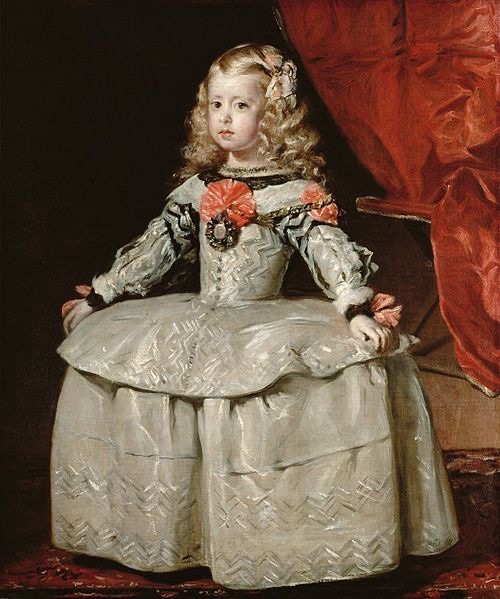
Städel Museum, Frankfurt.
I also, loved a painting called Idealised Portrait of a Young Woman as Flora by Bartolomeo Veneto. I’ve been especially drawn to portraits, not just because the garments are easier to study in them, but because portraits tend to focus more specifically on detail. That painting was so beautiful, I even bought it as a postcard to take home with me.
You’ve probably noticed she’s partially nude, something that in itself, becomes part of the art and the outfit. Her hair doesn’t look real, but rather like something made from a rare material; it shines like gold. The details of the leaves, the necklace, and even the flowers she holds like a prop all contribute to the sense that this isn’t just a portrait, but a carefully constructed image of beauty, wealth, and symbolism.
In this case, I see fashion because it is incorporated through accessories. She’s only wearing light fabric that seems to fall so particularly, perhaps even unintentionally, that everything harmonizes with one another. The amulet she wears in the center of her forehead symbolizes power to me, and the flowers suggest that she is posing as Flora, the Greek goddess of flowers (The name of the portrait gives that away too).
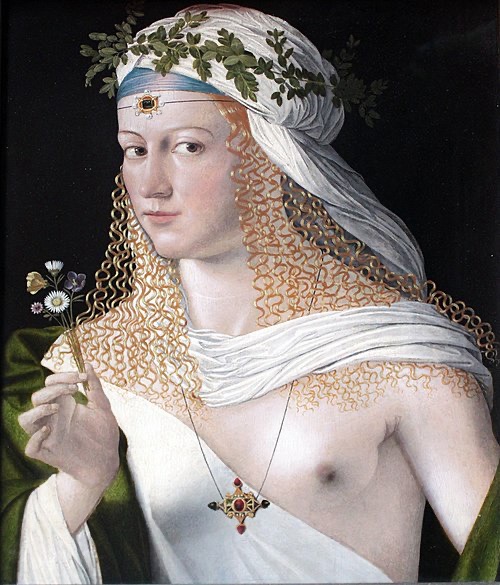
Idealized Portrait of a Young Woman as Flora by Bartolomeo Veneto.
Städel Museum, Frankfurt.
And lastly, the other day for my birthday, a group of girls and I went to the Blanton Museum of Art in Austin, Texas. Not necessarily European, but it contained European styles and artists. Saint Emerentiana by Francisco de Zurbarán stood out to me like no other in terms of fashion. Her dress is so carefully painted that you can truly see the creases in the fabric, almost feel them, and even imagine what the fabric is made of. With a closer look, her dress seems to be made of very thick material; which would have been expensive, since more material meant more money. The little clear lace fabric around her neck impressed me the most. I can imagine it being really hard to paint a piece of clothing that is transparent, yet in this painting it’s done beautifully. Overall, I found the contrast of the colors (nude pink, pond green, gold, and blue in the dress) to be surprisingly compatible with each other. In general, I thought her garments were some of the best I’ve ever seen depicted in a painting.
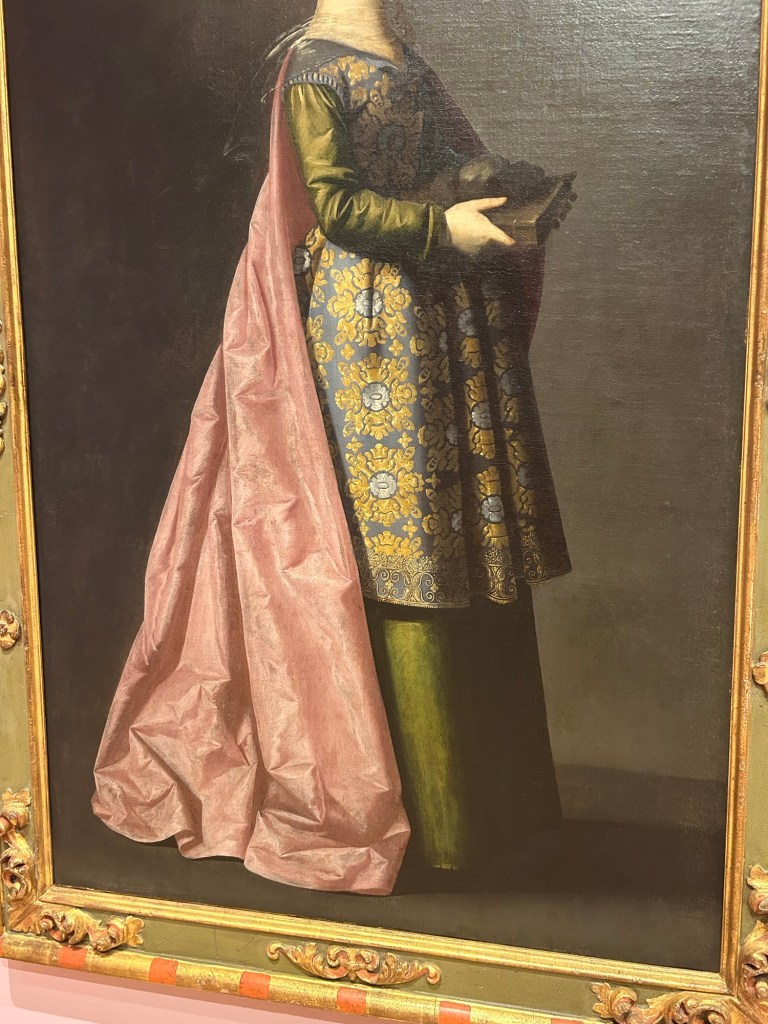
In the Blanton Museum of Art.
There’s something about fashion in art that connects across time; it’s not just about how people looked, but how they wanted to be seen too. The outfits in the paintings often told the world who they were, or at least who they wanted to be. Just like today, clothing in portraits was used to show status, beauty, personality, or even to fit into certain roles. When we look at these painted garments, we’re not just seeing fabric, we’re seeing choices, stories, and identities that still feel human and familiar.
 Styled Essence
Leave a comment